
Blog
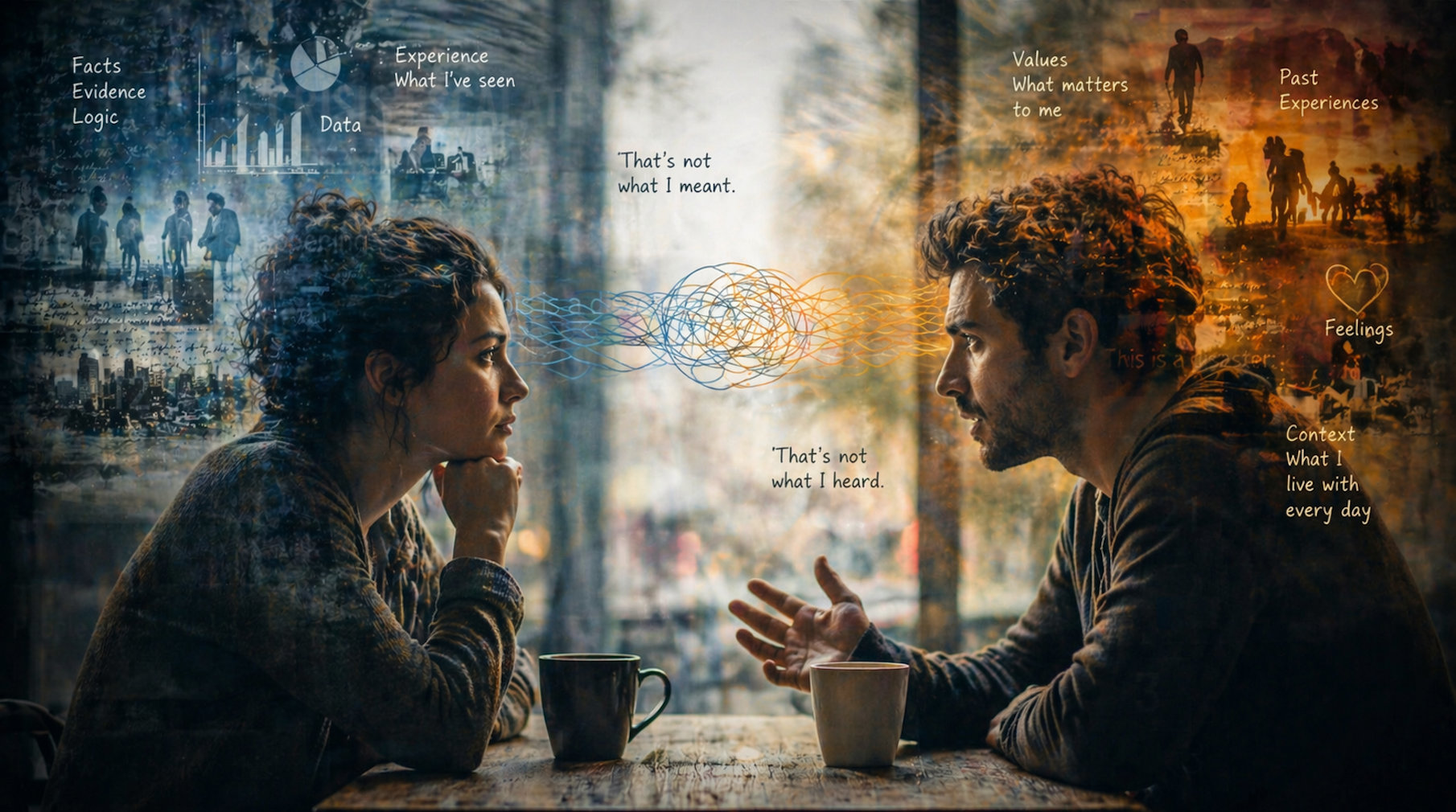
In my last article, we looked at something that happens instantly — how meaning forms before we notice it, and how what feels like a clear view of what’s happening simply appears.
It happens within each of us, and most critically, between us.
In a world that feels increasingly disconnected and fragmented, no matter how hard we try, we can’t seem to find a way forward.
For most of us, it doesn’t feel like we’re trying to disconnect. If anything, it feels like the opposite. We’re making the effort to understand, to explain, to respond in a way that lands. Even in difficult conversations, there is usually some sense — however faint — that connection is possible.
And yet, we keep being disappointed.
Our conversations feel more tentative. It doesn’t take much for them to sour — a word that lands slightly off, a tone that feels different than expected. Even when nothing is explicitly wrong, there is often a sense that something has already started to separate underneath what’s being said.
What’s interesting is that the same thing is happening to everyone involved. In the same moment, something is already emerging in the others as well — not after the exchange, but as part of it. The sense-making processes are responding to one another.
But what they are working with is not the same.
What each of us brings into the moment is shaped by what we’ve seen, heard, learned, repeated, and come to rely on. What stands out, what feels important, what seems obvious is already influenced by that. So even though we are in the same conversation, what is forming is not coming from the same place.
There are moments where this becomes especially visible. You finish explaining your perspective, and the other person pauses for a half-second too long before saying, 'That’s an interesting way to look at it.' To them, it is a genuine moment of quiet processing. But to you—informed by past experiences of polite rejection—it feels like a wall just went up. Within seconds, what felt promising feels unrecoverable.
But it can also linger.
What makes this difficult is not just that we see things differently, but that immediate reaction doesn’t appear to be taking shape. It appears as what is there.
So what shows up in me feels like me — clear, immediate, and justified. And what comes from someone else doesn’t appear as something forming in them, but as something they are doing — something intentional, something directed.
It doesn’t feel like something happening step by step. The sense of what’s happening is already there, along with what to expect and how to respond. By the time it reaches awareness, it already feels complete — whether it shows up as a thought, a feeling, or words already in motion.
In the past, we rarely had to bridge these gaps on a daily basis because our worlds were much smaller. We interacted mostly with people who were shaped by the same local environment. The daily context was shared. The baseline assumptions were largely the same. And even when there was friction, there was more continuity in how we related. People stayed in roles longer. Relationships had time to grow. There was a chance to understand how someone saw things, not just what they said.
But the modern world accelerated the collisions and eroded continuity.
Many of the interactions we have now are shaped less by ongoing relationships and more by roles that shift, rotate, and move quickly. We meet each other through positions, responsibilities, and short windows of exchange, often without the shared context that used to build over time.
Now, we are constantly interacting with people whose sense-making processes were built in entirely different environments, leaving us with little common ground.
They have very different lenses — different experiences, different assumptions, different ways of making sense of the same moment. Even when the words are shared, what they point to isn’t always shared.
That isn’t a problem in itself — it’s what happens in a highly connected world.
That’s where things start to slip — not only in what is said, but also in how it is heard.
Not because people don’t care, and not because someone isn’t trying, but because what we’re hearing doesn’t match what we expected to hear. A word lands differently than intended. A response feels off, and something that seemed aligned a moment ago suddenly doesn’t.
From there, it moves quickly. What the other person says starts to feel deliberate. What we heard starts to feel complete. And the gap between those two closes into a conclusion.
“They don’t see it the way I do.”
“They’re missing something obvious.”
“They’re choosing to respond this way.”
And once that happens, the conversation begins to narrow. Not by decision, but by how it now feels.
And in that moment, it doesn’t feel like something happening between two people.
It feels like something that is already settled.
The immediate reaction in those moments doesn’t feel optional. The reaction is already there. The interpretation already carries weight. The response feels like the only thing that makes sense to say or do.
But, from within it, there isn’t a sense of choosing between alternatives. There is just what fits, given what is being seen.
And the same is true on the other side.
We don’t experience someone else's response as a natural reflex. It appears as an active decision — a calculated move they didn't have to make.
That’s where blame begins to take hold.
Not because it’s chosen, but because what appears already looks deliberate.
But if what is showing up is already the only response that makes sense from within that moment, then the situation changes.
Not in what is being said, but in how it is understood.
It becomes harder to reduce it to someone being careless, or stubborn, or unwilling to see. And it becomes clearer that what is happening is constrained by what is visible from where each of us stands.
In the moment, it rarely feels that way.
It feels like something was said that shouldn’t have been.
Like something was missed that should have been obvious.
Like conversation has already gone somewhere it can’t come back from.
And once it feels that way, the response follows. The explanation forms, and the distance widens.
But something else is there, at the same time.
Not as an idea, and not as something we try to do, but as part of what is already happening. Even when the responses don’t match, there is still an effort to make sense of what’s happening — a response to uncertainty, a search for footing.
That’s easy to miss.
Because the narrative that emerges looks so different.
And if that begins to register, even slightly, what is possible in that moment starts to change.
Disagreement doesn't disappear. But what we are relating to changes. We stop seeing an opponent, and start seeing someone who is moving from very similar biological impulses we are — someone just trying to find their footing in a rush of assumptions.
When we finally see that shared reality, we are no longer just looking at the conflict. We are looking at something underneath it that has been there all along.