
Blog
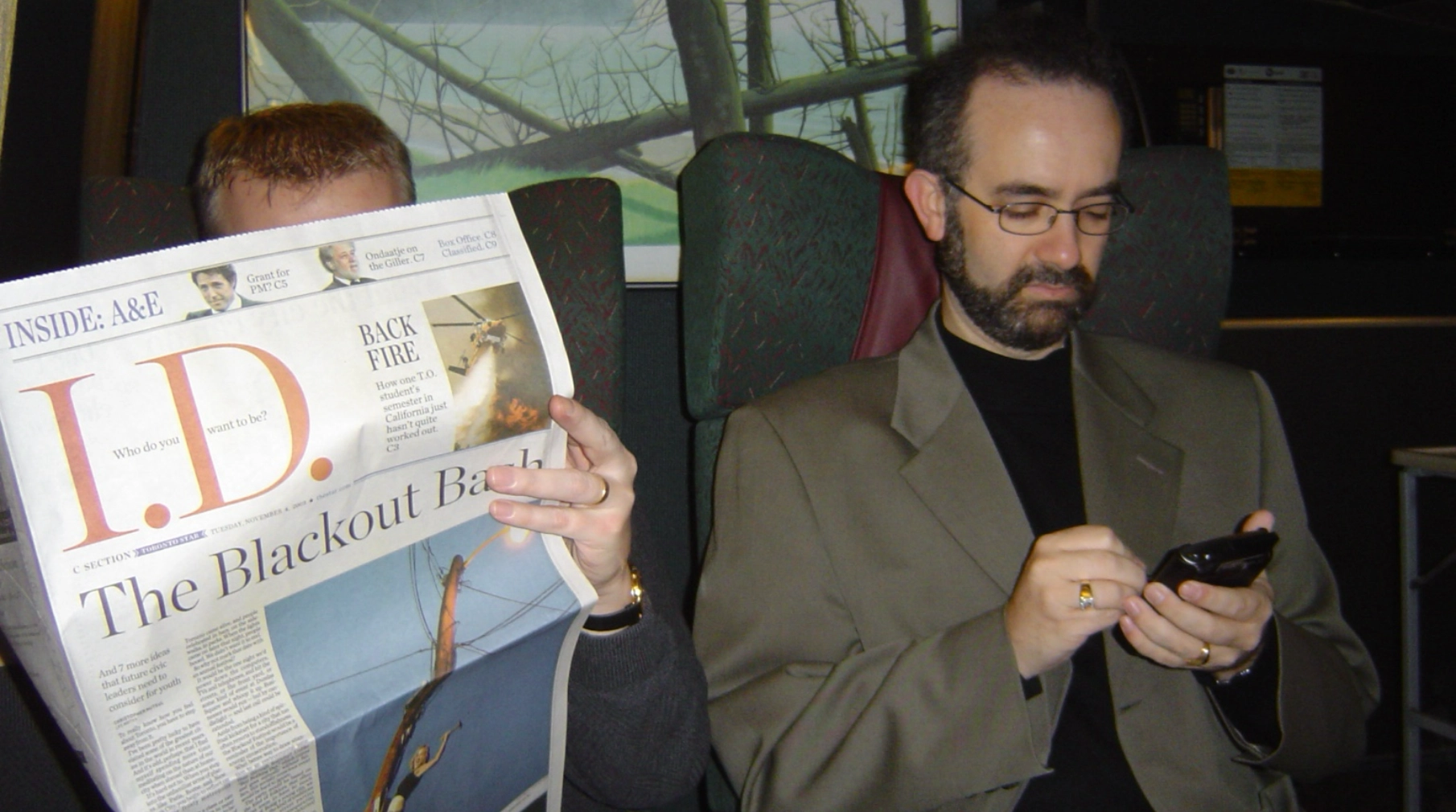
This was me — suit on, iPAQ in hand — trying to become the leader the system expected.
I didn’t yet understand that the more you hold on to authority, the more you lose relationship.
I learned about power long before anyone gave me a title.
But the moment I truly felt its weight came after Autonet was acquired by Sun Media.
We were young, scrappy, hopeful. We believed the acquisition would give us reach, resources, and a chance to build something bigger than we could on our own. We started meeting with regional publishers across Canada, excited to bring our teams together. The path ahead felt full of potential.
And then everything went quiet.
Emails weren’t returned. Voice mails went unanswered. Meetings we thought were confirmed suddenly vanished from calendars. We assumed people were busy, or that we had misread expectations. Weeks passed. Then months. The silence grew heavier.
Six months later, a VP of Classifieds in Alberta finally called me.
He lowered his voice, asked me not to tell anyone he told me, and said:
“We were told to shut you out. He’s using your deal to position himself to become CEO of Canoe.”
He explained that a publisher, someone we barely knew, had decided to use our renegotiation as leverage in his own campaign for power. His strategy was simple: starve our project of cooperation, make it look like we were the ones failing, then offer himself as the person who could “make a better deal.”
I remember standing there in disbelief.
I was stunned to realize:
we were being played like chess pieces.
Then the anger came.
Nothing in my career has ever enraged me as much as realizing that dozens of people’s work — our work — had been sacrificed for someone else’s climb up the ladder.
Effort didn’t matter. Innovation didn’t matter. What we had built didn’t matter.
What mattered was the logic of the hierarchy.
In that moment, something in me shifted.
I saw that power, as practiced in most institutions, wasn’t about creating.
It was about positioning, perception, and pressure.
A story people acted out because they believed this was what leadership was supposed to look like.
Control disguised as competence.
Deceit disguised as strength.
Isolation disguised as authority.
Years later, when I became a vice president of Canoe, I felt the other side of it.
There is a moment when a title lands on your desk and, for a brief second, you feel bigger.
People look at you differently.
Rooms open.
Decisions flow toward you.
But the gift comes wrapped in something you don’t notice right away: distance.
People defer to you.
People perform for you.
People hide things from you.
Not because of you—but because of what your role represents.
You gain authority.
And lose relationship.
I tried hard to keep relationships alive, but it didn’t work.
It took me too long to see that authority and relationship rarely coexist inside hierarchy.
Authority gives you control, yes.
But it also gives you a weight you cannot name:
The pressure to know.
The pressure to decide.
The pressure to hold consequences alone.
It isolates you from the very people you need in order to lead.
The higher you go, the more you become convinced that you are separate from the very people you need.
This is power in the story-dominant world:
the belief that leadership requires control, not connection.
Only later did I see what had been happening all along.
There was a moment in a meeting with a project team at Canoe I’ll never forget.
I walked in with a solution already formed in my mind — the “right answer,” the one a vice president is expected to provide. But as I spoke, I could feel the room pulling away: people nodding politely, eyes dropping to the table, the subtle signs of silent compliance.
Then someone gently offered a different idea.
I reluctantly paused.
I asked them to walk me through it.
In minutes, the whole room opened — people leaning in, building on one another, laughing, solving the problem together.
Nothing had changed except one thing: I stopped directing, and started listening.
That’s when I started to understand:
People don’t follow authority.
They follow resonance — the person who listens, who collaborates, who admits not knowing, who treats them as partners instead of resources.
Hierarchy has the power to force compliance.
But not to create trust.
And trust is the only real power there is.
My influence didn’t grow when I learned how to direct people.
It grew when I learned how to join them.
When I stopped trying to be the one who knew
and became the one who noticed.
When decisions became conversations.
When authority became transparency.
When pressure became interdependence.
That is when teams came alive.
Not because I had power,
but because we did.
Through the Life Lens, power looks nothing like hierarchy.
It’s not the ability to control outcomes.
It’s the ability to support conditions where life can unfold.
Power becomes:
Life does not centralize power.
Life distributes it.
Every organism, every relationship, every community participates in the work of direction, adaptation, and meaning-making. No species, system, or leader stands above the web of life — only within it.
In life, power is not dominance.
Power is contribution.
Not the authority to direct,
but the capacity to support.
I didn’t know any of this while I was at Canoe.
Back then, I was still trying to succeed inside the story I had inherited, the story that said leadership meant knowing, directing, deciding.
Maybe that’s why I left.
I couldn’t find myself in that version of power.
It took years to see power differently.
And I still fall back into old patterns.
But the difference now is that I’m trying to live life’s version, the kind that grows from connection, not control.
When you think about your own life, your own leadership, your own work —
when did your real influence come from listening, not directing?
And what would power look like if its purpose wasn’t to control life, but to serve it?